Work: In a Landscape (1948) for Solo Piano or Harp
Composer: John Cage
I chose to listen to John Cage just to expose my listening experiences, as I don’t usually listen to music of such a genre. I could not find a proper MP3 recording of the work, thus I listened to a YouTube upload of it. The piece was played on the piano
1st Listening
During my first round of listening, the first impression that I had of the piece was that it was extremely dreamy, smoothing and relaxing. The music was actually melodious to a large extent. It was really not something that I had expected coming from an avant-garde artiste like John Cage, because I have always had the impression that avant garde music would not be so “tuneful”.
The music was at a slow and tranquil pace throughout. It was mostly based on the use of pentatonic scales. Because of the dreamy and reflective mood and slow pace of the piece, the music sounded like a track from a sad scene of a movie. The dreamy and pastorale interpretation also brought to mind distant Gamelan echoes in the setting of European plains. The work seems to be largely based on repeated sections, which are at times repeated with different pitch centres.
Around the 6th minute, I heard chords in the lower register and this gave a slightly dramatic turn to the piece. These low-range chords were heard again closer to the 9th minute of the piece and in other points of the music thereafter too. Overall, the piece was mainly spread across the mid-range and high-range registers.
Throughout the whole course of listening, I kept having the impression that the music would have a sudden change in mood and break out of the quiet state to become more dramatic. However, the music maintained its status quo with little variation in the overall mood.
2nd and 3rd listening
During my 2nd and 3rd time listening, I listened in greater detail and managed to capture more information about the piece.
Timing Significant features
Opening - Piece opens with the note ‘A’
- It seems as if the pitch centre of this opening section is that of ‘A’
- ‘A’ occurs many times in this opening section
- The opening phrases feature ‘A’ in the mid-register
00:55 - ‘A’ is now occurring in the higher register
01:34 - Chords now occur in the lower register
01:58 - There seems to be a change of pitch centre here
- The note ‘D’ keeps occurring
- Similar material from the previous sections is used again here
- The music seems to be in the ‘D’ pitch centre this time
3:24 - The musical material here is familiar once again
- The music seems to have gone back to the ‘A’ pitch centre
04:02 - New material is heard
04:56 - The new material repeats
05:56 - Heavier-sounding chords in the lower register are heard “all of a sudden”
- This changes the mood of the piece a little, and makes it seem as if the music is going through a gloomy phase
- The first of the heavy chords sounded like a D chord
- Overall, this section sounded like it was in the ‘D’ pitch centre
06:48 - The note ‘D’ keeps occurring
07:05 - I hear what seemed like a series of repeated motives
07:35 - Material from the opening sections recur, but in a higher register
- The music here seems to be in the ‘D’ pitch centre
07:53 - The music goes back to being in the ‘A’ pitch centre
- Music goes back to the middle register
- The motives here are all familiar-sounding
8:34 to end - The lower register chords start coming back
- Familiar material here
- Music seems to be in ‘D’ pitch centre in this closing section
- Phrases keep ending with the note D
- There is a recurring melody that ends with the note D
- Music fades away and ends on a ‘D’
Post-listening
The following are some details I found out in my research done after my listening. “In a Landscape” by John Cage was dated to have been written in Black Mountain, North Carolina, in August 1948. The composition was actually written for a dance. It was dedicated to Louise Lippold and the dance was choreographed by Louise Lippold as well. The composition, together with the choreography, premiered on August, 20 1948. “In a Landscape” was published in 1960 under the Peters Edition. This same company also published “John Cage: Pianoworks (1935-1948)”.
The rhythmic structure of the piece is that of 15 x 15 measures (5-7-3), following the structure of the dance for which it was written. The piece is similar to another work of John Cage’s, titled “Dream”, but the fixed range of tones is more extensive. Resonances are sustained throughout the composition, by using both pedals. The sound of the composition is very soft and meditative, reminding of the music of Erik Satie. This probably explains the dreamy and pastorale nature of the piece.
Thursday, September 22, 2011

Monday, April 5, 2010
(9) You Raise Me Up - My final interpretation of the song
The song “You Raise Me Up” is a little bit philosophical; this music shows the pain of people’s lives, and the belief that God will help them.
"You Raise Me Up” starts with the smooth sound of a piano. The vocalist, Josh Groban, then enters and sings softly, “When I am down and, oh my soul, so weary when troubles come and my heart burdened be”. These lines introduce the reason for the song’s title. People always have problems facing their own weaknesses of mind and worry about their problems. Brendan Graham, through his lyrics, tries to feel and explain what people deal with every day in their normal lives. The first line mentions some insecure words like ‘down’, ‘weary’, ‘troubles’, and ‘burdened’, which describe the negative feelings and mindsets that people might have. Therefore, “You Raise Me Up” serves the purpose of touching the hearts of people and empathising with them.
"Then, I am still and wait here in the silence until you come and sit a while with me” is one part of the song which speaks calmly but firmly to people. This line brings out the main theme of the song: that there is somebody – it could be God – that can take care of and help people when they are in trouble and sorrow. ‘I am still and wait here in the silence’ gives the impression of the song being sung in a church setting. Whenever people need help and want to have peace in their mind, they might go to a church or silent room to pray, so that God can hear them, and they can listen to him. The line ‘until you come and sit a while with me’ expresses how strongly Brendan Graham believes in God, that being with God is consoling and makes one comfortable.
The word ‘mountains’ can be interpreted into different meanings. It can mean achieving the highest grade for students, good health for sick people, and all-around well-being for everybody else. In his lyrics, Brenhan Graham gives all honour to God. Because God gives his shoulder to people, so that they have something to lean on, people can thus gain the courage to take a step forward in this scary world and overcome their obstacles. This could be why the vocalist Josh Groban sings the full part of the chorus several times with a passionate and powerful voice and emphasizes the following verse again at the end: “You raise me up, to more than I can be”. It connotes hope and praise to God, which allows people to overcome hardship and finally be peaceful.
"You Raise Me Up” starts with the smooth sound of a piano. The vocalist, Josh Groban, then enters and sings softly, “When I am down and, oh my soul, so weary when troubles come and my heart burdened be”. These lines introduce the reason for the song’s title. People always have problems facing their own weaknesses of mind and worry about their problems. Brendan Graham, through his lyrics, tries to feel and explain what people deal with every day in their normal lives. The first line mentions some insecure words like ‘down’, ‘weary’, ‘troubles’, and ‘burdened’, which describe the negative feelings and mindsets that people might have. Therefore, “You Raise Me Up” serves the purpose of touching the hearts of people and empathising with them.
"Then, I am still and wait here in the silence until you come and sit a while with me” is one part of the song which speaks calmly but firmly to people. This line brings out the main theme of the song: that there is somebody – it could be God – that can take care of and help people when they are in trouble and sorrow. ‘I am still and wait here in the silence’ gives the impression of the song being sung in a church setting. Whenever people need help and want to have peace in their mind, they might go to a church or silent room to pray, so that God can hear them, and they can listen to him. The line ‘until you come and sit a while with me’ expresses how strongly Brendan Graham believes in God, that being with God is consoling and makes one comfortable.
The word ‘mountains’ can be interpreted into different meanings. It can mean achieving the highest grade for students, good health for sick people, and all-around well-being for everybody else. In his lyrics, Brenhan Graham gives all honour to God. Because God gives his shoulder to people, so that they have something to lean on, people can thus gain the courage to take a step forward in this scary world and overcome their obstacles. This could be why the vocalist Josh Groban sings the full part of the chorus several times with a passionate and powerful voice and emphasizes the following verse again at the end: “You raise me up, to more than I can be”. It connotes hope and praise to God, which allows people to overcome hardship and finally be peaceful.
(8) You Raise Me Up - Rhythmic & Metrical Analysis
1. Rhythm
The rhythm is largely even, with a constant flow of quavers and semiquavers in the melody, and a constant flow of quavers and crotchets in the piano accompaniment part.
2. Meter
The song is largely in the simple time of 4/4 with one exception in bar 3, where it becomes 6/4.
The rhythm is largely even, with a constant flow of quavers and semiquavers in the melody, and a constant flow of quavers and crotchets in the piano accompaniment part.
2. Meter
The song is largely in the simple time of 4/4 with one exception in bar 3, where it becomes 6/4.
Sunday, April 4, 2010
(7) You Raise Me Up - Analysis of Melody & Vocal Characteristics
The melody of the song is largely diatonic.
1. Use of melisma
There is the use of melisma in this song, whereby the vocalist sings 2 or more consecutive pitches to a given syllable of the lyrics.
One example would be the melisma on the syllable “tains” in the word "mountains”. Josh Groban sings the notes G, F and Eb for this syllable in bar 22.
Another example would be the melisma on the word “raise”. He sings the notes F and Eb for this word in bar 22, the notes G and F for the same word in bar 38, and notes Ab and Gb in bar 47.
Yet another example would be the melisma on the syllable “y’ in the word "stormy”. He sings the notes Ab and Bb for this syllable in bar 23, the notes Bb and C for the same word in bar 39, and the notes C and Db in bar 48.
2. Vocal Characteristics
According to the score, this song is in a higher tessitura for soprano. However, the vocalist Josh Groban sings it within his tenor range.
1. Use of melisma
There is the use of melisma in this song, whereby the vocalist sings 2 or more consecutive pitches to a given syllable of the lyrics.
One example would be the melisma on the syllable “tains” in the word "mountains”. Josh Groban sings the notes G, F and Eb for this syllable in bar 22.
Another example would be the melisma on the word “raise”. He sings the notes F and Eb for this word in bar 22, the notes G and F for the same word in bar 38, and notes Ab and Gb in bar 47.
Yet another example would be the melisma on the syllable “y’ in the word "stormy”. He sings the notes Ab and Bb for this syllable in bar 23, the notes Bb and C for the same word in bar 39, and the notes C and Db in bar 48.
2. Vocal Characteristics
According to the score, this song is in a higher tessitura for soprano. However, the vocalist Josh Groban sings it within his tenor range.
Friday, April 2, 2010
(6) You Raise Me Up - Structural Analysis
1. Structure in terms of Form
Here is the outline of my analysis of the structure of the song in terms of the form.
A – Introduction (Bars 1 to 12)
A’ – Verse (Bars 12 to 20)
B – 1st Chorus (Bars 20 to 28)
A’ – Violin solo (Bars 28 to 36)
B’ – 2nd Chorus (Bars 36 to 44)
B’ – 3rd Chorus (Bars 45 to 53)
B’ – 4th Chorus (Bars 53 to 62)
C – Outro in the form of a Cadential Extension (Bars 62 to 66)
As shown above, the song mainly consists of 2 distinct sections of musical material, A and B. Both sections A and B take turns to be repeated, with some modifications in some instances, but still maintaining the similar musical material overall.
The song only has one verse, but the chorus is repeated four times, possibly because Brendan Graham felt it was important to send this hopeful message through the song;
You raise me up, so I can stand on mountains
I am strong, when I am on your shoulders
You raise me up, to more than I can be.
The chorus talks about what people can do with God’s strength. In this verse, one can interpret how hard the lives are for those who are waiting for God. Ultimately, God comes and raises them up to high positions.
The last section, section C, is the Outro in the form of a cadential extension. I decided to label it as “C” because I feel that the musical material is actually a hybrid of the material from sections A and B. The lyrics in section C is derived from the chorus in section B, while I feel that harmonic aspect of the music in section C is actually more similar to that of section A. Hence my conclusion that section C is a hybrid of the musical material from both sections A and B.
2. Structure in terms of Phrasing
Here is my analysis of the structure of the song in terms of the phrasing. The essential phrase structure of the song is seen to be maintained for most of the song. Let us take a look at the phrase structure of the Introduction (bars 1 to 12) as an example.
There appears to be what seems like a 2-2-4 type of sentence structure in the Introduction section. The first “2-bar” sentence occurs from bar 1 to the second half of bar 3. The next “2-bar” sentence occurs from the second half of bar 3 to the end of bar 5. The final “4-bar” sentence occurs from the second half of bar 6 and leads to a perfect cadence at the start of bar 11. These would leave about 2 bars before we reach the end of the Introduction; these remaining music would then constitute as a single unit on its own, and can be considered as a short transition linking the beginning of the piece to the Verse section when the vocalist starts to sing.
This basic 2-2-4 sentence structure is seen to be maintained for the rest of the song, except for the music towards the end of the song, from the 4th Chorus onwards, where there are a few remaining bars towards the end of the song that does not fit into the 2-2-4 sentence structure as before. These remaining bars would then constitute as a single unit on their own, as the song's Outro in the form of a cadential extension.
Here is the outline of my analysis of the structure of the song in terms of the form.
A – Introduction (Bars 1 to 12)
A’ – Verse (Bars 12 to 20)
B – 1st Chorus (Bars 20 to 28)
A’ – Violin solo (Bars 28 to 36)
B’ – 2nd Chorus (Bars 36 to 44)
B’ – 3rd Chorus (Bars 45 to 53)
B’ – 4th Chorus (Bars 53 to 62)
C – Outro in the form of a Cadential Extension (Bars 62 to 66)
As shown above, the song mainly consists of 2 distinct sections of musical material, A and B. Both sections A and B take turns to be repeated, with some modifications in some instances, but still maintaining the similar musical material overall.
The song only has one verse, but the chorus is repeated four times, possibly because Brendan Graham felt it was important to send this hopeful message through the song;
You raise me up, so I can stand on mountains
I am strong, when I am on your shoulders
You raise me up, to more than I can be.
The chorus talks about what people can do with God’s strength. In this verse, one can interpret how hard the lives are for those who are waiting for God. Ultimately, God comes and raises them up to high positions.
The last section, section C, is the Outro in the form of a cadential extension. I decided to label it as “C” because I feel that the musical material is actually a hybrid of the material from sections A and B. The lyrics in section C is derived from the chorus in section B, while I feel that harmonic aspect of the music in section C is actually more similar to that of section A. Hence my conclusion that section C is a hybrid of the musical material from both sections A and B.
2. Structure in terms of Phrasing
Here is my analysis of the structure of the song in terms of the phrasing. The essential phrase structure of the song is seen to be maintained for most of the song. Let us take a look at the phrase structure of the Introduction (bars 1 to 12) as an example.
There appears to be what seems like a 2-2-4 type of sentence structure in the Introduction section. The first “2-bar” sentence occurs from bar 1 to the second half of bar 3. The next “2-bar” sentence occurs from the second half of bar 3 to the end of bar 5. The final “4-bar” sentence occurs from the second half of bar 6 and leads to a perfect cadence at the start of bar 11. These would leave about 2 bars before we reach the end of the Introduction; these remaining music would then constitute as a single unit on its own, and can be considered as a short transition linking the beginning of the piece to the Verse section when the vocalist starts to sing.
This basic 2-2-4 sentence structure is seen to be maintained for the rest of the song, except for the music towards the end of the song, from the 4th Chorus onwards, where there are a few remaining bars towards the end of the song that does not fit into the 2-2-4 sentence structure as before. These remaining bars would then constitute as a single unit on their own, as the song's Outro in the form of a cadential extension.
Thursday, April 1, 2010
(5) You Raise Me Up - Harmonic Analysis
1. Chords and their functions
For my harmonic analysis, I focused more on the music in bars 1-28 and bars 60-66, because the harmonic analysis in between these 2 sections is very similar to that of the front sections of the song. Here is my analysis of the chords and their functions for the respective sections of the song.
The harmony of the song is largely diatonic.
1 a. Introduction – Bars 1 to 12
The song begins in the key of E flat major.

As shown above, we see the use of some Classical harmonic clichés at cadential points; however, they occur in a way that might be termed as a "reinvention", if I might put it in this manner.
For example, in bar 5, there is a suspended Eb over the Bb chord V in Eb major. We expect the suspended Eb to resolve to a D, however, the Eb is suspended and help throughout bar 5 until the first half of bar 6, and the D only appears as the last note of bar 6. Even then, it did not appear in the same voice as the suspended Eb.
There is a similar case of a "reinvention" of the suspension in bars 9 to 10. In bar 9, the Eb is somewhat prepared by the reiteration of the same note in the first half of bar 9; however, the G does not seem to have been prepared in any way. While the G is implied to be suspended and somewhat momentararily resolved to F over the chord V in bar 10, the Eb, which is suspended, does not resolve, and still continues to sound in the second half of bar 10.
1 b. Verse – Bars 12 to 20
The song is still in Eb major in this section.

In this section, we again come across the “reinvention” of a Classical harmonic cliché at cadential points.
In bar 13, there appears to be an implied suspension of an Eb in the Bb chord V. However, this Eb does not resolve to the expected D. All this happens over a tonic pedal in the bass.
1 c. 1st Chorus – Bars 20 to 28
The song is still in Eb major in this section.

In this section, we again come across the “reinvention” of a Classical harmonic cliché at cadential points.
For example, in bar 27, there appears to be a suspended Eb and G. While the Eb appears to resolve to a D in the second half of the bar, the G is only implied to be suspended, as there is no obvious resolution of the note to the expected F.
1 d. Violin solo – Bars 28 to 36
In terms of the harmony, what I found in the Verse in bars 12 to 20 is around the same in this violin solo section. The main difference is that the key of the song changes from Eb major to Bb major in this violin solo section.
1 e. 2nd Chorus – Bars 36 to 44
The chorus comes back for a 2nd time in bars 36 to 44. The harmony found in the 1st Chorus in bars 20 to 28 is very similar to that of this 2nd Chorus. The main difference is that this 2nd chorus is in the key of Bb major.
1 f. 3rd Chorus – Bars 45 to 53
The chorus is sung again for the 3rd time in bars 53 to 61. Once again, the harmony found here is similar to the previous 3 choruses. This time, however, the chorus appears in the key of Gb major, as the music changes from Bb major to Gb major in bar 45.
1 g. 4th Chorus – Bars 53 to 62
The chorus is sung for the last time in bars 53 to 61. In terms of the harmony, the last chorus in this section is also rather similar to all the other previous occurrences of the chorus in the song. The key in this section remains in Gb major. However, there is one striking difference in this section which distinguishes it from the rest of the other sections, and that is the use of what seems to be a deceptive resolution of V at the end of this section. This is a common type of cadential extension. Let us take a look at the chords leading up to the resolution of this section.

Instead of resolving the V7 directly to I in a perfect cadence which could have ended the phrase (and the song itself), the composer chose to resolve to the submediant chord, vi, instead. This gives an element of surprise to the listener, who would be expecting the conventional resolution to the tonic chord, especially after hearing several instances of that in the previous reprises of the chorus. The resolution from V7 to I is then followed a chord IV, which appears to have the function of prolonging the “tonic” before that.
I h. Outro in the form of a Cadential Extension – Bars 62 to 66
The Outro is what is known as the "lead-out" or ending to a song. Here, the music continues in the key of G flat major, and eventually closes in this key. The Outro seems to be in the form of a cadential extension , a common feature of songs. The cadential extension takes the form of reiterations of the cadences leading up to a perfect cadence once again, as if to confirm that is indeed that final cadence.

For my harmonic analysis, I focused more on the music in bars 1-28 and bars 60-66, because the harmonic analysis in between these 2 sections is very similar to that of the front sections of the song. Here is my analysis of the chords and their functions for the respective sections of the song.
The harmony of the song is largely diatonic.
1 a. Introduction – Bars 1 to 12
The song begins in the key of E flat major.

As shown above, we see the use of some Classical harmonic clichés at cadential points; however, they occur in a way that might be termed as a "reinvention", if I might put it in this manner.
For example, in bar 5, there is a suspended Eb over the Bb chord V in Eb major. We expect the suspended Eb to resolve to a D, however, the Eb is suspended and help throughout bar 5 until the first half of bar 6, and the D only appears as the last note of bar 6. Even then, it did not appear in the same voice as the suspended Eb.
There is a similar case of a "reinvention" of the suspension in bars 9 to 10. In bar 9, the Eb is somewhat prepared by the reiteration of the same note in the first half of bar 9; however, the G does not seem to have been prepared in any way. While the G is implied to be suspended and somewhat momentararily resolved to F over the chord V in bar 10, the Eb, which is suspended, does not resolve, and still continues to sound in the second half of bar 10.
1 b. Verse – Bars 12 to 20
The song is still in Eb major in this section.

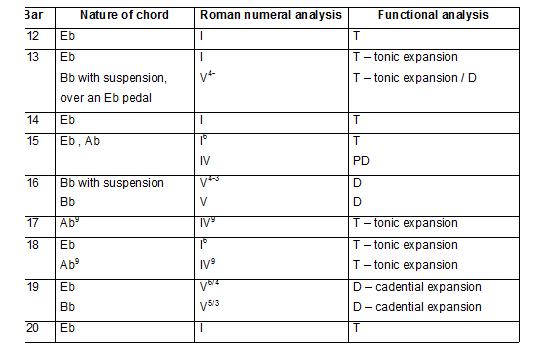
In this section, we again come across the “reinvention” of a Classical harmonic cliché at cadential points.
In bar 13, there appears to be an implied suspension of an Eb in the Bb chord V. However, this Eb does not resolve to the expected D. All this happens over a tonic pedal in the bass.
1 c. 1st Chorus – Bars 20 to 28
The song is still in Eb major in this section.

In this section, we again come across the “reinvention” of a Classical harmonic cliché at cadential points.
For example, in bar 27, there appears to be a suspended Eb and G. While the Eb appears to resolve to a D in the second half of the bar, the G is only implied to be suspended, as there is no obvious resolution of the note to the expected F.
1 d. Violin solo – Bars 28 to 36
In terms of the harmony, what I found in the Verse in bars 12 to 20 is around the same in this violin solo section. The main difference is that the key of the song changes from Eb major to Bb major in this violin solo section.
1 e. 2nd Chorus – Bars 36 to 44
The chorus comes back for a 2nd time in bars 36 to 44. The harmony found in the 1st Chorus in bars 20 to 28 is very similar to that of this 2nd Chorus. The main difference is that this 2nd chorus is in the key of Bb major.
1 f. 3rd Chorus – Bars 45 to 53
The chorus is sung again for the 3rd time in bars 53 to 61. Once again, the harmony found here is similar to the previous 3 choruses. This time, however, the chorus appears in the key of Gb major, as the music changes from Bb major to Gb major in bar 45.
1 g. 4th Chorus – Bars 53 to 62
The chorus is sung for the last time in bars 53 to 61. In terms of the harmony, the last chorus in this section is also rather similar to all the other previous occurrences of the chorus in the song. The key in this section remains in Gb major. However, there is one striking difference in this section which distinguishes it from the rest of the other sections, and that is the use of what seems to be a deceptive resolution of V at the end of this section. This is a common type of cadential extension. Let us take a look at the chords leading up to the resolution of this section.

Instead of resolving the V7 directly to I in a perfect cadence which could have ended the phrase (and the song itself), the composer chose to resolve to the submediant chord, vi, instead. This gives an element of surprise to the listener, who would be expecting the conventional resolution to the tonic chord, especially after hearing several instances of that in the previous reprises of the chorus. The resolution from V7 to I is then followed a chord IV, which appears to have the function of prolonging the “tonic” before that.
I h. Outro in the form of a Cadential Extension – Bars 62 to 66
The Outro is what is known as the "lead-out" or ending to a song. Here, the music continues in the key of G flat major, and eventually closes in this key. The Outro seems to be in the form of a cadential extension , a common feature of songs. The cadential extension takes the form of reiterations of the cadences leading up to a perfect cadence once again, as if to confirm that is indeed that final cadence.

Monday, March 8, 2010


Sunday, February 21, 2010
(3) You Raise Me Up – Video performances of song
Video 1
Josh Groban sings "You Raise Me Up" on the Ellen deGeneres show.
Watch it at: http://www.youtube.com/watch?v=W_l_A6-7td0
Video 2
Josh Groban sings “You Raise Me Up” at a concert.
Watch it at: http://www.youtube.com/watch?v=quZTdeUgiV8
Josh Groban sings "You Raise Me Up" on the Ellen deGeneres show.
Watch it at: http://www.youtube.com/watch?v=W_l_A6-7td0
Video 2
Josh Groban sings “You Raise Me Up” at a concert.
Watch it at: http://www.youtube.com/watch?v=quZTdeUgiV8
(2) You Raise Me Up – Lyrics of song
When I am down and, oh my soul, so weary;
When troubles come and my heart burdened be;
Then, I am still and wait here in the silence,
Until you come and sit awhile with me.
You raise me up, so I can stand on mountains;
You raise me up, to walk on stormy seas;
I am strong, when I am on your shoulders;
You raise me up: To more than I can be.
You raise me up, so I can stand on mountains;
You raise me up, to walk on stormy seas;
I am strong, when I am on your shoulders;
You raise me up: To more than I can be.
There is no life - no life without its hunger;
Each restless heart beats so imperfectly;
But when you come and I am filled with wonder,
Sometimes, I think I glimpse eternity.
You raise me up, so I can stand on mountains;
You raise me up, to walk on stormy seas;
I am strong, when I am on your shoulders;
You raise me up: To more than I can be.
You raise me up, so I can stand on mountains;
You raise me up, to walk on stormy seas;
I am strong, when I am on your shoulders;
You raise me up: To more than I can be.
When troubles come and my heart burdened be;
Then, I am still and wait here in the silence,
Until you come and sit awhile with me.
You raise me up, so I can stand on mountains;
You raise me up, to walk on stormy seas;
I am strong, when I am on your shoulders;
You raise me up: To more than I can be.
You raise me up, so I can stand on mountains;
You raise me up, to walk on stormy seas;
I am strong, when I am on your shoulders;
You raise me up: To more than I can be.
There is no life - no life without its hunger;
Each restless heart beats so imperfectly;
But when you come and I am filled with wonder,
Sometimes, I think I glimpse eternity.
You raise me up, so I can stand on mountains;
You raise me up, to walk on stormy seas;
I am strong, when I am on your shoulders;
You raise me up: To more than I can be.
You raise me up, so I can stand on mountains;
You raise me up, to walk on stormy seas;
I am strong, when I am on your shoulders;
You raise me up: To more than I can be.
(1) You Raise Me Up – Background of song
"You Raise Me Up" is a popular song in the inspirational mould. The music was written by Secret Garden's Rolf Løvland and the lyrics by Brendan Graham. The song has now been covered more than 125 times.
The song was originally written as an instrumental piece and titled "Silent Story." The melody is based on a traditional Irish tune (especially the opening phrase of its chorus), the Londonderry Air, which is best known as the usual tune to the 1910 song Danny Boy. Løvland approached Irish novelist and songwriter Brendan Graham to write the lyrics to his melody after reading Graham's novels. It was originally released on the 2002 Secret Garden album "Once in a Red Moon," with the vocals sung by Irish singer Brian Kennedy, and sold well in both Ireland and Norway. Originally, Brian Kennedy was supposed to follow Secret Garden on their Asian tour in 2002, but fell ill, and could not attend. He was replaced by Norwegian singer Jan Werner Danielsen, who also later recorded the song together with Secret Garden, but it was never released.
In 2003, David Foster decided to produce the song after being introduced to it by Frank Petrone of peermusic, the song's publisher. He chose the up-and-coming Josh Groban to record the song, which was accompanied by the great tenor Craig Von Vennik of the Establishment, which proved very popular in the US. His version made it to the top of the Billboard adult contemporary chart and remained there for six weeks. Groban also performed it at Super Bowl XXXVIII, in a special NASA commemoration for the crew of the Space Shuttle Columbia disaster. A special surprise performance by Groban, for Oprah Winfrey's 50th birthday, also gave "You Raise Me Up" massive international prominence. The Groban recording also was nominated for a 2005 Grammy award. Groban also performed it at the first Idol Gives Back Concert, along with the African Children's Choir.
Source: http://en.wikipedia.org/wiki/You_Raise_Me_Up
The song was originally written as an instrumental piece and titled "Silent Story." The melody is based on a traditional Irish tune (especially the opening phrase of its chorus), the Londonderry Air, which is best known as the usual tune to the 1910 song Danny Boy. Løvland approached Irish novelist and songwriter Brendan Graham to write the lyrics to his melody after reading Graham's novels. It was originally released on the 2002 Secret Garden album "Once in a Red Moon," with the vocals sung by Irish singer Brian Kennedy, and sold well in both Ireland and Norway. Originally, Brian Kennedy was supposed to follow Secret Garden on their Asian tour in 2002, but fell ill, and could not attend. He was replaced by Norwegian singer Jan Werner Danielsen, who also later recorded the song together with Secret Garden, but it was never released.
In 2003, David Foster decided to produce the song after being introduced to it by Frank Petrone of peermusic, the song's publisher. He chose the up-and-coming Josh Groban to record the song, which was accompanied by the great tenor Craig Von Vennik of the Establishment, which proved very popular in the US. His version made it to the top of the Billboard adult contemporary chart and remained there for six weeks. Groban also performed it at Super Bowl XXXVIII, in a special NASA commemoration for the crew of the Space Shuttle Columbia disaster. A special surprise performance by Groban, for Oprah Winfrey's 50th birthday, also gave "You Raise Me Up" massive international prominence. The Groban recording also was nominated for a 2005 Grammy award. Groban also performed it at the first Idol Gives Back Concert, along with the African Children's Choir.
Source: http://en.wikipedia.org/wiki/You_Raise_Me_Up
AAI 104 Pop Song Blog Analysis
You Raise Me Up
In this analysis, we will be focusing on the version sung by Josh Groban.
In this analysis, we will be focusing on the version sung by Josh Groban.
Monday, November 2, 2009
DISCLAIMERS!!!
Dr Chong:
1) Please ignore the markings I made on the copy of the score that I gave you. The WRITTEN ANALYSIS below is the updated analysis. The marked analysis on the score is NOT THE UPDATED/CORRECT one.
2) If you need to keep track, my first post was actually on Oct 2 (that post has since been deleted). Older posts from October have been transferred to another page by blogspot, you must click on another link on the right hand side.
Thanks for the trouble!
grace
1) Please ignore the markings I made on the copy of the score that I gave you. The WRITTEN ANALYSIS below is the updated analysis. The marked analysis on the score is NOT THE UPDATED/CORRECT one.
2) If you need to keep track, my first post was actually on Oct 2 (that post has since been deleted). Older posts from October have been transferred to another page by blogspot, you must click on another link on the right hand side.
Thanks for the trouble!
grace
Stand By Me - Analysis (Part 3)
a continuation...
Rhythmic Analysis
There is also the use of syncopation in this song, whereby we see that there is an emphasis or implied accent on the weaker beats. For instance, in bar 1, because of the tied D in the melody, the notes that follow after that stress the second half of beats 3 and 4, giving it a syncopated feel.
Rhythmic Analysis
There is also the use of syncopation in this song, whereby we see that there is an emphasis or implied accent on the weaker beats. For instance, in bar 1, because of the tied D in the melody, the notes that follow after that stress the second half of beats 3 and 4, giving it a syncopated feel.
Stand By Me - Analysis (Part 2)
Here is a continuation of the post below :)
Melodic Analysis
After a brief introductory phrase at the start, the song begins with a catchy tune. The distinguishing factor between the first and second verse is the melodic contour that follows after both instances of "Stand by me". The melodic contour of the music in bar 4 after the first instance of "Stand by me" in the bar before, is a scalic movement upwards. Compare this with the octave leap in bar 8 that follows after the second instance of "Stand by me" in the bar before that. The octave leap in the second instance provides dramatic contrast and is musically satisfying as a melody.
Rhythmic Analysis
This song is not easy to sing or play because of the frequent feature of metrical displacement. The metrical displacement in this piece occurs in various different forms. One is the way in which notes across the bar-lines are tied or held. This can be seen in bars 1-2, 5-6, 13-14, and 15-16. Another way in which metrical displacement occurs is how the notes are tied or held across the second and third beats in a bar. This is evident in bars 1, 2, 3, 4, 5, 7, 8, 9, 11, 12, 13, 14, 15, 16, 17, 18. As we can see, metrical displacement is quite prevalent in just the first page of the score, and this is something that can throw the pianist off-guard.
Melodic Analysis
After a brief introductory phrase at the start, the song begins with a catchy tune. The distinguishing factor between the first and second verse is the melodic contour that follows after both instances of "Stand by me". The melodic contour of the music in bar 4 after the first instance of "Stand by me" in the bar before, is a scalic movement upwards. Compare this with the octave leap in bar 8 that follows after the second instance of "Stand by me" in the bar before that. The octave leap in the second instance provides dramatic contrast and is musically satisfying as a melody.
Rhythmic Analysis
This song is not easy to sing or play because of the frequent feature of metrical displacement. The metrical displacement in this piece occurs in various different forms. One is the way in which notes across the bar-lines are tied or held. This can be seen in bars 1-2, 5-6, 13-14, and 15-16. Another way in which metrical displacement occurs is how the notes are tied or held across the second and third beats in a bar. This is evident in bars 1, 2, 3, 4, 5, 7, 8, 9, 11, 12, 13, 14, 15, 16, 17, 18. As we can see, metrical displacement is quite prevalent in just the first page of the score, and this is something that can throw the pianist off-guard.
Stand By Me - Analysis (Part 1)
Background Information
The above is from the piano score for an original popular Korean song called “Stand By Me”. This is one of the theme songs in the popular Korean drama serial called “Boys Over Flower”.
Here is a link to a recording-cum-video featuring the song:
http://www.youtube.com/watch?v=7oUDrWTWpJs
Harmonic Analysis
The song is in the key of C major. Bar 1 is outlined with a tonic C major chord. The harmony in bar 2 is very unique. It consists of an F major chord with an added G in the upper part, played over a C tonic octave pedal in the lower part. I analysed the overall chord in bar 2 to be that of IVc.
The music in bar 3 goes through chords IV and V, which are chords F and G in the key of C major. In bar 4, the harmony goes through chords iii and vi, which are chords E minor and A minor respectively. The whole of bar 5 is in chord ii7, which is the seventh D minor chord in the key of C major. This is followed by a D major chord V in bar 6. Together, the chord ii7 in bar 5 and the chrod V in bar 6 form what appears to be an imperfect cadence.
Bars 7 to 9 go through a similar chord progression as bars 3 to 6. The harmony is largely the same. For instance, both the music in bars 3 and 7 go through chords IV followed by V. In fact, not only is the harmony the same, the notes in bars 3 and 7 are actually exactly the same.
Similarly, bars 4 and 8 go through the same harmony - both progress through chord iii followed by chord vi. The harmony in bar 5 is same as that of the first half of bar 9. In the second half of this bar, the music then progresses to a very unique harmony – an F major chord in the upper part over a G major chord in the lower part. I analysed the overall chord to be an eleventh dominant chord, or V11. The music then moves to a seventh C major chord, or I7 chord. These last 3 chords, ii7, V and I7, make up a cadential progression which gives the music a sense of closure.
In the music that follows after, we once again see the use of similar chord progressions as the sections before. For example, bars 11 to 14 goes through the same harmony as that of bars 3 to 6. In comparison, bars 15 to 18 have the same harmonic progression as bars 7 to 10, with the only difference being that the second half of bar 17 is in an ordinary chord V in G major, unlike the more decorated V11 in the second half of bar 9.
Functional Analysis
The harmony in bar 1 appears to have a tonic function. This tonic function goes through an expansion in bar 2, as can be seen from the continued C bass. Thereafter the music seems to have a largely predominant function, until the presence of the dominant V chord in bar 6.
The music from bar 7 onwards has a predominant function. This continues till the V11 chord in bar 9, which clearly has a dominant function. This is followed by a tonic chord with a tonic function in bar 10.
What we see in bars 11 to 14 is similar to that of bars 3 to 6. The chord progression in both instances are the same, and thus we can say that the functional harmony should generally be the same as well.
This is also the case for bars 15 to 18, which have the same harmonic progression as bars 7 to 10. The functional analysis in both instances are largely the same as well.
Phrase Structure and/or Sentence Analysis
The song opens with a 2-bar phrase, something I would call an Introductory Phrase. What we see after this appears to be a simple period. We see an Antecedent Phrase which spans 4 bars, from bar 3 to 6. This is followed by a Consequent Phrase which is outlined in the next 4 bars, from bars 7 to 10. Together, these two 4-bar phrases form a simple period.
The 4-bar phrase structure of this song appears to be quite regular. This can be seen from the second Antecedent Phrase which, like the first Antecedent Phrase in bars 3 to 6, occurs over a span of 4 bars, from bars 11 to 14.
However, we can see a distinct difference in this second Antecedent Phrase. It is sort of linked to the second Consequent Phrase, as can be seen from how the music continues seamlessly to bar 15, which marks the start of the second occurrence of the Consequent Phrase. The second Consequent Phrase is outlined in bars 15 to 18, and together with the previous Antecedent Phrase, these make up the second simple period.
The above is from the piano score for an original popular Korean song called “Stand By Me”. This is one of the theme songs in the popular Korean drama serial called “Boys Over Flower”.
Here is a link to a recording-cum-video featuring the song:
http://www.youtube.com/watch?v=7oUDrWTWpJs
Harmonic Analysis
The song is in the key of C major. Bar 1 is outlined with a tonic C major chord. The harmony in bar 2 is very unique. It consists of an F major chord with an added G in the upper part, played over a C tonic octave pedal in the lower part. I analysed the overall chord in bar 2 to be that of IVc.
The music in bar 3 goes through chords IV and V, which are chords F and G in the key of C major. In bar 4, the harmony goes through chords iii and vi, which are chords E minor and A minor respectively. The whole of bar 5 is in chord ii7, which is the seventh D minor chord in the key of C major. This is followed by a D major chord V in bar 6. Together, the chord ii7 in bar 5 and the chrod V in bar 6 form what appears to be an imperfect cadence.
Bars 7 to 9 go through a similar chord progression as bars 3 to 6. The harmony is largely the same. For instance, both the music in bars 3 and 7 go through chords IV followed by V. In fact, not only is the harmony the same, the notes in bars 3 and 7 are actually exactly the same.
Similarly, bars 4 and 8 go through the same harmony - both progress through chord iii followed by chord vi. The harmony in bar 5 is same as that of the first half of bar 9. In the second half of this bar, the music then progresses to a very unique harmony – an F major chord in the upper part over a G major chord in the lower part. I analysed the overall chord to be an eleventh dominant chord, or V11. The music then moves to a seventh C major chord, or I7 chord. These last 3 chords, ii7, V and I7, make up a cadential progression which gives the music a sense of closure.
In the music that follows after, we once again see the use of similar chord progressions as the sections before. For example, bars 11 to 14 goes through the same harmony as that of bars 3 to 6. In comparison, bars 15 to 18 have the same harmonic progression as bars 7 to 10, with the only difference being that the second half of bar 17 is in an ordinary chord V in G major, unlike the more decorated V11 in the second half of bar 9.
Functional Analysis
The harmony in bar 1 appears to have a tonic function. This tonic function goes through an expansion in bar 2, as can be seen from the continued C bass. Thereafter the music seems to have a largely predominant function, until the presence of the dominant V chord in bar 6.
The music from bar 7 onwards has a predominant function. This continues till the V11 chord in bar 9, which clearly has a dominant function. This is followed by a tonic chord with a tonic function in bar 10.
What we see in bars 11 to 14 is similar to that of bars 3 to 6. The chord progression in both instances are the same, and thus we can say that the functional harmony should generally be the same as well.
This is also the case for bars 15 to 18, which have the same harmonic progression as bars 7 to 10. The functional analysis in both instances are largely the same as well.
Phrase Structure and/or Sentence Analysis
The song opens with a 2-bar phrase, something I would call an Introductory Phrase. What we see after this appears to be a simple period. We see an Antecedent Phrase which spans 4 bars, from bar 3 to 6. This is followed by a Consequent Phrase which is outlined in the next 4 bars, from bars 7 to 10. Together, these two 4-bar phrases form a simple period.
The 4-bar phrase structure of this song appears to be quite regular. This can be seen from the second Antecedent Phrase which, like the first Antecedent Phrase in bars 3 to 6, occurs over a span of 4 bars, from bars 11 to 14.
However, we can see a distinct difference in this second Antecedent Phrase. It is sort of linked to the second Consequent Phrase, as can be seen from how the music continues seamlessly to bar 15, which marks the start of the second occurrence of the Consequent Phrase. The second Consequent Phrase is outlined in bars 15 to 18, and together with the previous Antecedent Phrase, these make up the second simple period.
Sunday, November 1, 2009
Saturday, October 31, 2009

The above is an original popular Korean song called “Stand By Me”. It is one of the theme songs in the popular Korean drama serial called “Boys Over Flower”.
The song is in C major and it opens with a 2-bar phrase, something I would call an “Introductory Phrase”. Bar 1 is outlined with a tonic C major chord. The harmony in bar 2 is very unique. It consists of an F major chord with an added G in the upper part, played over a C tonic octave pedal in the lower part. I analysed the overall chord in bar 2 to be that of IVc.
The next section of the song is the “Antecedent Phrase” which spans 4 bars, from bar 3 to 6. The harmony from bar 3 goes through the predominant harmonic structure, with the chords IV, V, iii, vi and ii7, before arriving on the dominant G major chord in bar 6.
The section that follows after is the “Consequent Phrase” which is outlined in bars 7 to 10. The first 5 chords of this phrase go through the exact same chord progression as those of the phrase before, passing through chords IV, V, iii, vi and finally ii7, before going to chord V.
Bar 9, the 3rd bar of this phrase, starts with a chord ii7, a seventh D minor chord in this case. The music of this bar then progresses to a very unique harmony – an F major chord in the upper part over a G major chord in the lower part. I analysed the overall chord to be an eleventh dominant chord, or V11. The phrase ends in bar 10 on a seventh tonic chord.
The 4-bar phrase structure of this song appears to be quite regular. This can be seen from the 2nd Antecedent Phrase which, like the 1st Antecedent Phrase in bars 3 to 6, occurs over a span of 4 bars, from bars 11 to 14. Once again, for the 3rd time in a row, the phrase goes through the same predominant harmony, with the chords IV, V, iii, vi, and ii7, before arriving at the dominant G major chord in bar 14. However, we can see a distinct difference in this particular Antecedent Phrase. It is sort of linked with the 2nd Consequent Phrase, as can be seen from how the music continues seamlessly to bar 15, which is the start of the 2nd occurrence of the Consequent Phrase.
The Consequent Phrase, which is outlined in bars 15 to 18, similarly goes through the same chord progression as the 3 phrases before, and ends on a seventh C major chord in bar 18. This brings the first major section of the piece to a close.
The song is in C major and it opens with a 2-bar phrase, something I would call an “Introductory Phrase”. Bar 1 is outlined with a tonic C major chord. The harmony in bar 2 is very unique. It consists of an F major chord with an added G in the upper part, played over a C tonic octave pedal in the lower part. I analysed the overall chord in bar 2 to be that of IVc.
The next section of the song is the “Antecedent Phrase” which spans 4 bars, from bar 3 to 6. The harmony from bar 3 goes through the predominant harmonic structure, with the chords IV, V, iii, vi and ii7, before arriving on the dominant G major chord in bar 6.
The section that follows after is the “Consequent Phrase” which is outlined in bars 7 to 10. The first 5 chords of this phrase go through the exact same chord progression as those of the phrase before, passing through chords IV, V, iii, vi and finally ii7, before going to chord V.
Bar 9, the 3rd bar of this phrase, starts with a chord ii7, a seventh D minor chord in this case. The music of this bar then progresses to a very unique harmony – an F major chord in the upper part over a G major chord in the lower part. I analysed the overall chord to be an eleventh dominant chord, or V11. The phrase ends in bar 10 on a seventh tonic chord.
The 4-bar phrase structure of this song appears to be quite regular. This can be seen from the 2nd Antecedent Phrase which, like the 1st Antecedent Phrase in bars 3 to 6, occurs over a span of 4 bars, from bars 11 to 14. Once again, for the 3rd time in a row, the phrase goes through the same predominant harmony, with the chords IV, V, iii, vi, and ii7, before arriving at the dominant G major chord in bar 14. However, we can see a distinct difference in this particular Antecedent Phrase. It is sort of linked with the 2nd Consequent Phrase, as can be seen from how the music continues seamlessly to bar 15, which is the start of the 2nd occurrence of the Consequent Phrase.
The Consequent Phrase, which is outlined in bars 15 to 18, similarly goes through the same chord progression as the 3 phrases before, and ends on a seventh C major chord in bar 18. This brings the first major section of the piece to a close.
Sunday, October 11, 2009

The above is an original popular Korean song called “Stand By Me”. It is one of the theme songs in the popular Korean drama serial called “Boys Over Flower”.
The song is in C major and it opens with a 2-bar phrase, something I would call an “Introductory Phrase”. Bar 1 is outlined with a tonic C major chord. The harmony in bar 2 is very unique. It consists of an F major chord with an added G in the upper part, played over a C tonic octave pedal in the lower part. I analysed the overall chord in bar 2 to be that of IVc.
The next section of the song is the “Antecedent Phrase” which spans 4 bars, from bar 3 to 6. Bar 3 consists of an F major and G major chord, bringing the bar to end on a chord V. The harmony goes through the predominant harmonic structure, and goes through chords iii, vi and ii7, before arriving on the dominant G major chord in bar 6.
The section that follows after is the “Consequent Phrase” which spans another 4 bars, from bars 7 to 10. The first 2 bars of this phrase go through the exact same chord progression as the first 2 bars of the phrase before. Bar 9, the 3rd bar of this phrase, starts with a chord ii7, a seventh D minor chord in this case. The music of this bar then progresses to a very unique harmony – an F major chord in the upper part over a G major chord in the lower part. I analysed the overall chord to be an eleventh dominant chord. The phrase ends in bar 10 on a seventh tonic chord.
Subscribe to:
Posts (Atom)